A day of fungi in Kaslo
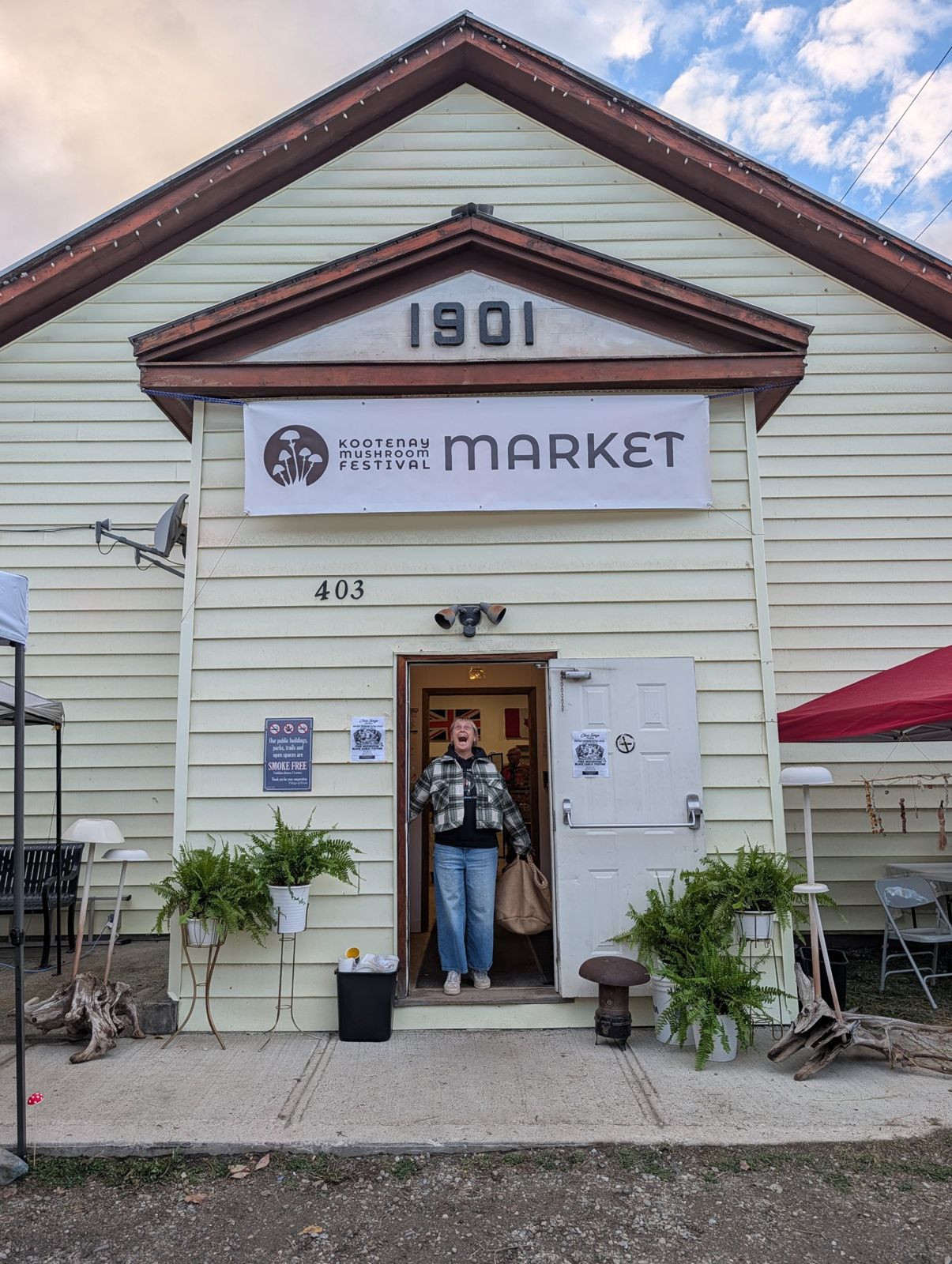
The fifth annual Kootenay Mushroom Festival filled Kaslo on Saturday, October 10, and it showed how much one grassroots event can teach a bioregion in a single day. What started in 2022 as a small gathering is now a full program of guided forays, expert ID tables, talks, workshops, an artisan market and a mushroom-inspired meals, spread across downtown Kaslo: the Kaslo Legion, St. Andrew's Church, the Langham Cultural Centre and our amazing farmers markets!
A huge thank you to the Kootenay Mycological Society team who make it happen: Robin Mercy of Mr. Mercy's Mushrooms, who pulls together the programming; Sydney Smith-Brinkman, who built the market; Taylor Olson, who kept the day running; Caroline McChesney on legal and admin; Leanne Reitan at the ID tables; Brian Bookhout on iNaturalist; Monique Gottlieb, on leave this year; and every volunteer who carried tables and answered questions. I've never been more excited about mycology and natural resource innovation.
I spent the day at the market, the ID tables and three talks: Chelsea McDowell on beginner mushroom foraging, the forestry panel on fungi and wildfire risk, and Patrick Kooyman on the science of psilocybin. Then I finished the night at the after party at St. Andrew's with Sean Rodman and Geoffrey Lundstrom, a fundraiser for the Kaslo Jazz Fest. Here is what I took away.
The forays and the ID tables
The morning started with colour-coded forays (red, orange, blue, green, purple and pink) heading into the woods around Kaslo with local experts. By midday their finds were laid out in hundreds of kraft trays, sorted by group, with laminated guides explaining each family. The ID team logs every species for the festival's species list and iNaturalist project, so the full count will come from them. From my photos alone I could pick out dozens of genera, many with several species each.
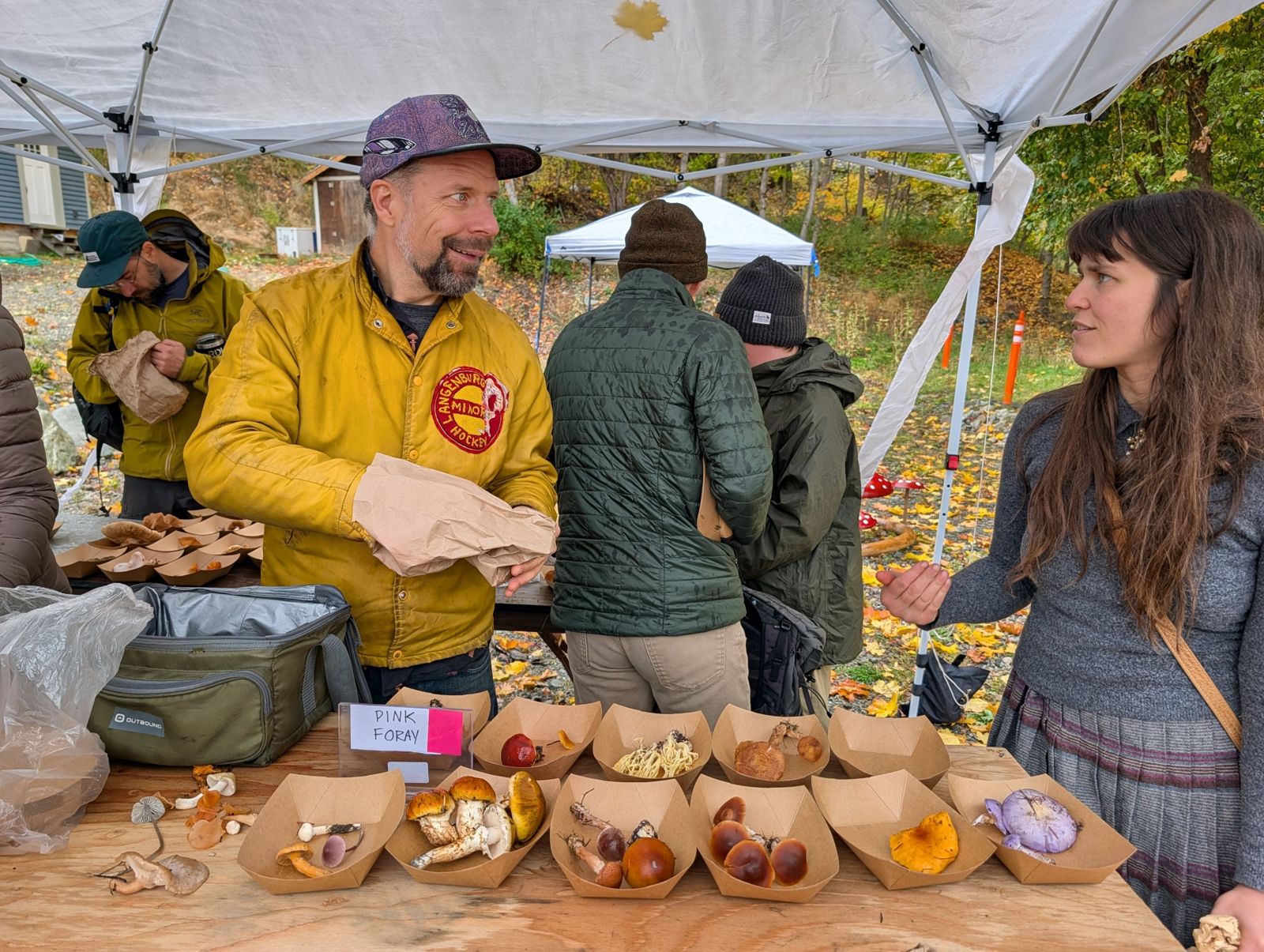
Each foray had its own leader and focus:
- Alan Perello: fundamentals of identification for beginners, on foot with lots of fungal variety.
- Tyson Ehlers: biologist and co-author of Mushrooms to Look for in the Kootenays, with a soft spot for slime moulds.
- Robin Mercy: longtime Selkirk College foray leader, mushroom grower and spawn kit specialist.
- Erik Hrabovsky: forager, cultivator and myco-remediator, covering mycelial connections, mushroom-tree associations and edibility.
- Heather Scott of Halcyon Wild Foods: wild edibles beyond mushrooms and the seasonal cycles of plants, fungi and animals.
- Candice Cullum: forager, bushcrafter and basket-weaver, focused on safe ID and collecting for crafts and dyes.
- Leanne and Alex Reitan: a science-focused foray, with participants logging finds on iNaturalist for the festival's documentation project.
- Patrick Kooyman: clinical herbalist and owner of Blue Lotus Ethnobotanicals, leading a health-focused walk.
In the afternoon, Leanne, Alex, Tyson and guests ran an Advanced Mushroom ID session at the tables outside the Legion, and Kaslo bryologist Pete Whitehead led a moss foray into the hills.
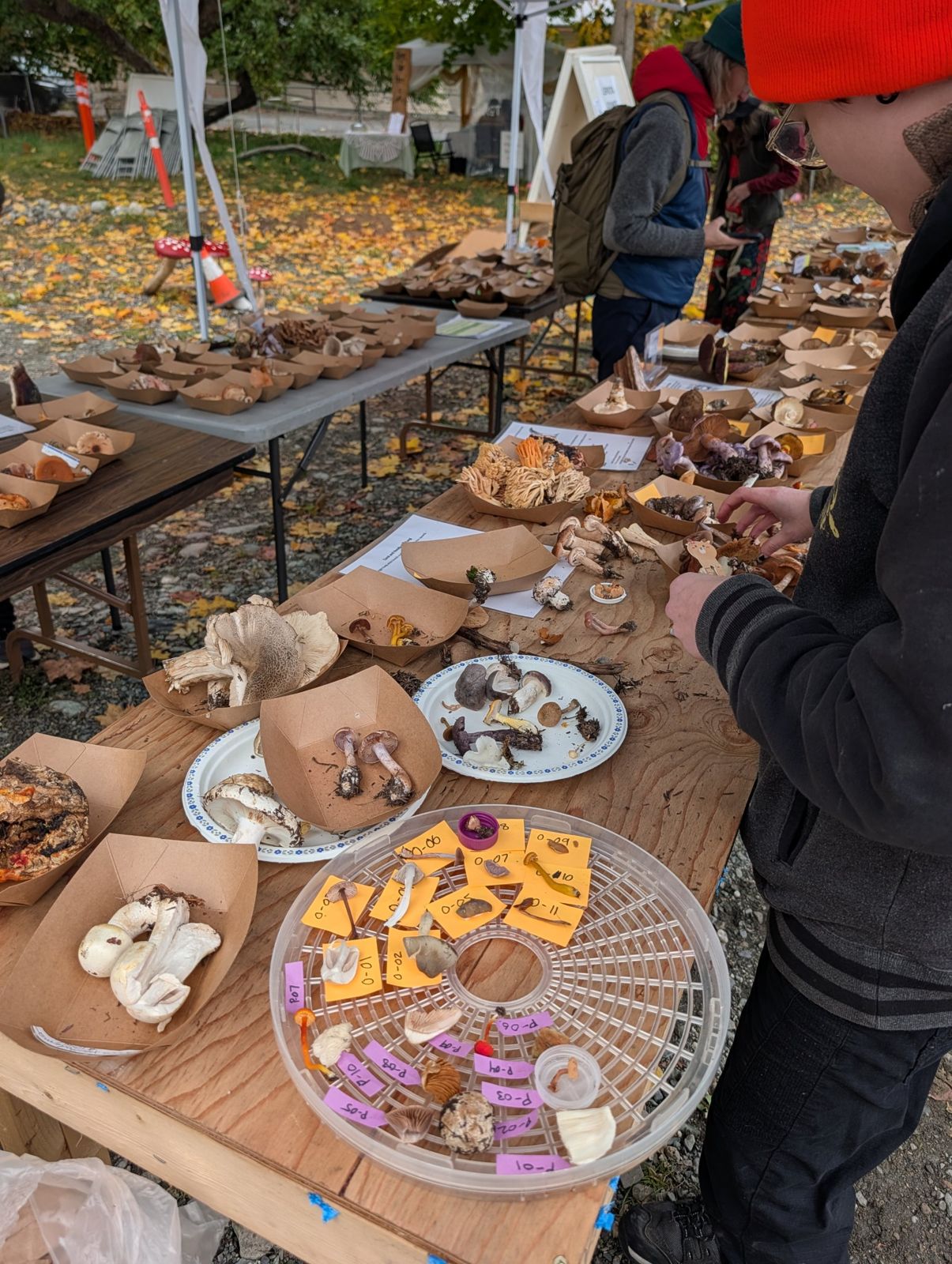
Standouts on the tables included admirable boletes (Aureoboletus mirabilis), lobster mushrooms, a whole table of purple and lilac webcaps (Cortinarius), bright orange and yellow Ramaria corals, and an artist's conk etched with a drawing.
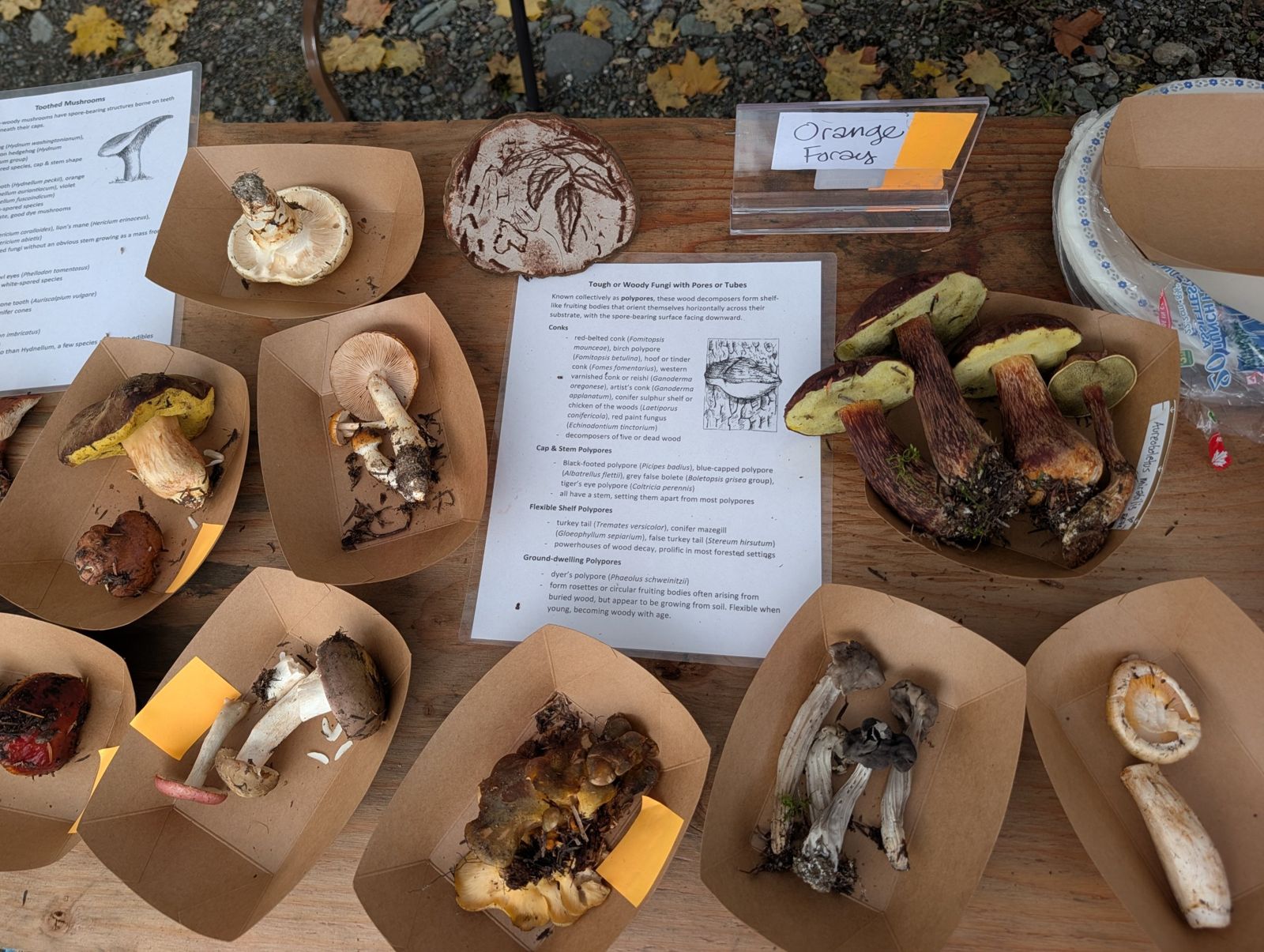
The tables also carried a clear safety message. Cortinarius includes species that cause fatal kidney failure, and Amanita includes the deadliest mushrooms in BC. Both were well represented. If you forage, learn from people who know, and never eat anything on a photo ID.
Talk: fungi, forestry and fire
The Mushrooms and Forestry panel at the Langham, with Heather Scott, Adrian Leslie, Andrew Bennett and guests, made the strongest case I heard all day for fungi as infrastructure. A local team is inoculating stumps and woodchip piles on cut blocks with Hypholoma (sulphur tuft), a harmless wood-rotter that outcompetes Armillaria, the root parasite that kills young trees after logging. The goal is to replace stumping, where heavy equipment pulls stumps out of the soil.
The early numbers are striking:
- Inoculated chip piles averaged about 35% mycelium coverage after one season, with some reaching 60%. Untreated piles averaged about 5%.
- Mycelium-covered chips held 30 to 40% moisture. In burn trials, untreated chips burned down about 10 cm with diesel, briquettes and leaf blowers. The fungal chips would not burn at all, which surprised a crew that burns piles for a living.
- Fuel treatment costs roughly $10,000 to $15,000 per hectare whether you burn or chip. Chipping can happen most of the year, and inoculating the piles may cut fire risk at little or no extra cost while keeping carbon and water on the landscape.
The team is also growing spawn outdoors in unpasteurized piles of mill sawdust, aiming to move production to mill sites and away from single-use plastic bags. Next steps are five one-hectare trials and a gravel lot burn test. What they need most is funding, bigger teams and a practical way to install inoculant on blocks with 1,500 or more stumps.
The speakers were also blunt about salvage logging: it often loses money and damages burned soils at exactly the time pyrophilic fungi are rebuilding them.
Talk: the science of psilocybin
In Psilocybin Mushrooms: History and Current Research at the United Church Hall, Patrick Kooyman traced psilocybin mushrooms from ancient history to current clinical trials. It was educational, not a how-to, and that framing mattered.
History. Mushroom stones and grinding stones found in Central America point to at least 2,500 years of use. Spanish colonizers and the church suppressed the practice so thoroughly that by the early 1900s some researchers doubted psychoactive mushrooms existed. Maria Sabina's ceremonies in Oaxaca reached the West through Gordon Wasson's 1957 Life magazine essay, which coined the term "magic mushrooms." Albert Hofmann then identified psilocybin and psilocin in the lab. The speaker also noted that the fame did not go well for Maria Sabina herself.
How it works. Psilocybin acts mainly on the 5-HT2A serotonin receptor; it does not deplete serotonin. It temporarily disrupts the brain's default mode network, and researchers think the small lasting changes in brain connectivity may explain long-term benefits. Whole mushrooms also contain related alkaloids, so they may act differently from pure pharmaceutical psilocybin.
Research cited. The speaker walked through recent small trials on depression, smoking cessation, OCD and post-treatment Lyme symptoms, plus an animal study on pain. Results were promising and generally well tolerated, but these are early, small studies that still need larger trials.
Safety. Some medications blunt or intensify effects, people with bipolar disorder face added risk, and the speaker stressed preparation, a trusted sober support person and integration afterward. On regulation, the key point was that "lab tested" on an unregulated product means little unless every batch is tested.
Legal status. In Canada, psilocybin remains illegal to possess, sell or grow without a Health Canada exemption or Special Access Program approval, despite storefronts in some cities. A private member's bill introduced in June 2026, Bill C-286, proposes a clearer medical access pathway. If you want to see psilocybin brought in line with marijuana and alcohol, we want to hear from you at klic@kootenays.org.
Workshops and the Button Stage
The afternoon also offered hands-on workshops: preserving the harvest with chef Ryan Steffler of Counter Cultured Foods, building a living mycelium scarecrow for the Kaslo Community Garden with Erik Hrabovsky of Free the Fungi, and dyeing with mushrooms with Candice Cullum. The Button Stage at the Legion kept the day moving with Son Cubano (Kevin John and Jay Danley), DJ Throwbekk, DJ Cbiggs and DJ SonicRobot, plus free talks from Chelsea McDowell and Amanita Herbs. A detail worth copying: volunteers in gold wristbands were first aid certified, so help was always easy to spot.
The market
The artisan market was a highlight of the day. Nearly 40 local makers, growers and organizations filled the space with food, medicine, art and conversation, and it showed how much mushroom culture has grown into a local economy. A few of the vendors:
- Mushrooms, herbs and botanicals: Meteor Mushrooms, Free the Fungi, Spiras Farms, Understory Herbals, Amanita Herbs, Blue Lotus Ethnobotanicals, Aumbrosia Essentials, Water Over Leaves
- Food and drink: Feed Your Soul Foods, Ricochet Pies, Halcyon Wild Foods, Forage and Fodder, Counter Cultured Foods, Viva Cacao, Rawsa Vegan Organic Desserts, Aakeal Birch Boba
- Art and craft: Felt Me Now, Fire and Stone Ceramics, Kootenay Carvings, Tied Up Dyes, Thrones Woven, Madarch Designs, Alexandra Bates Jewelry, Maple Bee Studio, Art By Nathanja, Art by Delanie Smith, Nikki Meraki Art, Forever Natural Photography
- Community: Valhalla Wilderness Foundation, WildSafe BC, Otter Books
If you missed it, look these folks up and support them through the year.
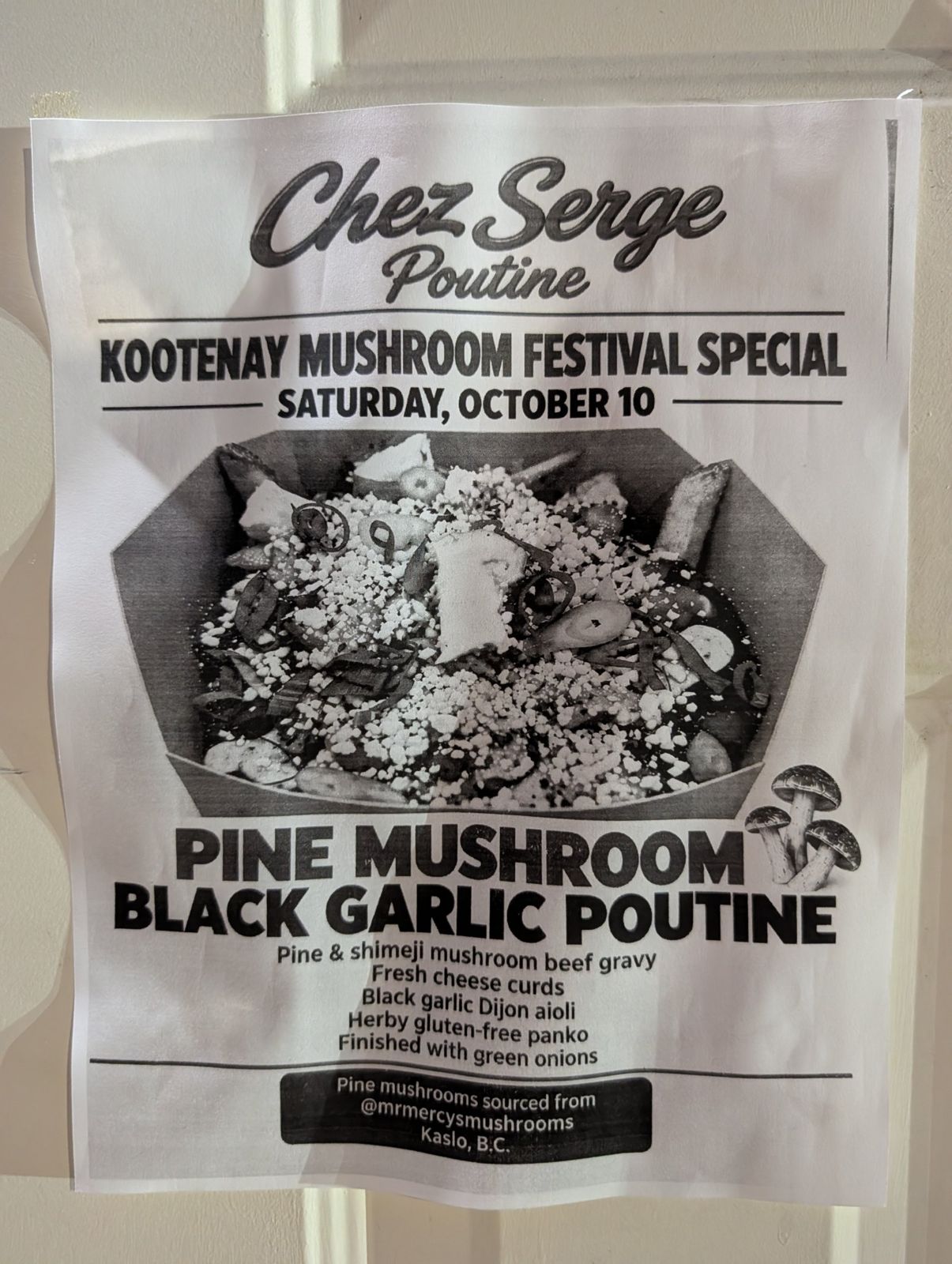
Food was part of the fungal theme too. Chez Serge Poutine ran a festival special: a pine mushroom black garlic poutine with pine and shimeji mushroom gravy, fresh curds and black garlic Dijon aioli, made with pine mushrooms from Mr. Mercy's Mushrooms in Kaslo. Alongside it, the Kaslo Hotel's Waypoint Restaurant served a pan-seared lion's mane "filet mignon" with smoked carrot purée, charred asparagus, red wine bordelaise and pickled mustard seeds.
Fungi beyond the forest
The fire-resistant chip piles are one small piece of a much bigger opportunity. Mycelium grown on farm and mill waste is already replacing petroleum-based foam: Ecovative makes packaging and insulation reported to be cost competitive with standard foams, and Mykor raised £4 million in 2026 to scale mycelium insulation into prefabricated wall systems. One industry analysis puts mycelium composites at negative embodied carbon, using about a tenth of the energy of conventional insulation to produce. Closer to home, UBC researchers are developing living fungi bricks, insulation and boards grown from sawdust and mushrooms like oyster, reishi and turkey tail, and NASA is funding habitats grown from dormant fungi for the Moon and Mars. With forests, mills, growers and researchers all in one region, the Kootenays have what it takes to build local mycelium building products, post-fire restoration services and new rural jobs.
Why it matters for the Kootenays
Fungi came up all day as working parts of a resilient region: rebuilding soil, holding water, slowing wildfire, feeding people and supporting mental health. These are the same life support systems we talk about in regenerative community design, and this festival puts the local experts in one place each fall.
I'd like to see it grow a year-round science and future track, with talks like these recorded and shared beyond Kaslo. If you want to get involved, reach the organizers at kootenaymushroomfestival@gmail.com or follow https://facebook.com/kootenaymushroomfestival.
At KLIC, we've been experimenting with growing homes with mycelium, and we're interested in speaking with anyone who wants to support nature's innovation in harmony with technology: researchers, growers, builders, funders and curious neighbours. Reach us at klic@kootenays.org.
Great work by KLIC board members Zia Fehrenbach and Justin Rahardjo, who helped with sound and organizational support. That's the KLIC mission: supporting critical local organizations and events to thrive.
In service,
>j-m